Thursday, October 14, 2010

Damsel in Distress? Wodehouse to the rescue!


‘Wodehouse’s idyllic world can never stale. He will continue to release future generations from captivity that may be more irksome than our own. He has made a world for us to live in and delight in’. 
Evelyn Waugh

Any one of Wodehouse’s works must feature in your list of books to read before you die. And if you’re not a very serious reader, I would suggest you pick any book on Wooster and Jeeves (the butler I wish I had! Carry on Jeeves) but in case you can’t get hold of Jeeves, A Damsel in Distress would do brilliantly.

Wodehouse stories revolve around British aristocracy, life in English country houses and golf. There will be a myriad of characters, each one with eccentric habits who find themselves in situations so absurd it’ll blow your mind off!

Percy's Hat goes flying!
Take this book for instance. The story opens at Belpher Castle, home to Lord Marshmoreton and his crazy family. His sister, Lady Caroline Byng wants her step-son, Reggie, to marry her brother’s daughter, Maud. Reggie is in love with Alice Faraday, Lord Marshmoreton’s secretary who is helping him to write his memoirs, a task Marshmoreton abhors (he would rather tend to his rose garden). Maud, Lord Marshmoreton’s only daughter, is in love with a young man whom she had met in Wales a year ago. And then there is Percy, Maud’s brother, heir of Belpher Castle.  He fits the aristocratic definition perfectly and has a similar stance as his aunt, Lady Caroline, in almost all matters.

Enter George who not only, unwillingly, becomes an accomplice to Maud’s escape from Percy but also sends his hat flying off his head in London (why is Maud escaping from her own brother?). Who is George? He’s an American music composer who happens to be in London with his performers and runs into Maud, one fine day, while sitting in his taxi. One thing leads to another and George finds himself madly in love with Maud. So much in love that he is willing to scale any walls, even those of Belpher Castle, hanging onto bedsheets for his dear life!

Hanging onto dear life!
Will George and Maud get together? Will Reggie be able to convince his step-mother that his heart desires Alice Faraday? Will Lord Marshmoreton finish his memoirs at the cost of his rose garden? Will Percy rule Belpher Castle with an iron fist?

Curious? Read the book!

Photographs (Percy's Hat & Hanging onto Dear life): Google Images

Monday, October 11, 2010

An Ideal Husband - Oscar Wilde

According to Wilde, ‘If you want to tell people the truth, make them laugh, otherwise they’ll kill you’.

An Ideal Husband is an 1895, comedic stage play. The action is set in London, in ‘the present’ and takes place over the course of twenty four hours (source: Wikipedia). The play revolves around blackmail, politics, and public honour. It also touches upon the subject of matrimony and what makes a husband, ideal.

Act I opens in the Chiltern household where a banquet of sorts is taking place. It is here that we are introduced to all the major characters; Sir Robert Chiltern, his wife, Lady Chiltern, his dandified friend Lord Goring, Goring’s father Lord Caver sham, Mabel Chiltern, Sir Robert’s younger sister and of course, Mrs. Cheveley.

Mrs. Cheveley is the perfect villain. She is ‘a genius in the daytime and a beauty at night’. Mrs. Cheveley has, in her possession, a letter from Sir Robert’s past which can ruin his public and private life. Everybody has skeletons in their closets and Sir Robert is no exception. The most unfortunate thing, for him, is that not only does the world but his wife, also, has no clue of this horrid letter from his past.

One of the long speeches from Act II is very interesting. Following is an excerpt of an exchange between Sir Robert Chiltern and his wife, Lady Chiltren after the latter found out the dreaded secret from her husband’s past.

“Lady Chiltern: .......And now- oh, when I think that I made of a man like you my ideal! The ideal of my life!

Sir Robert Chiltern: There was your mistake. There was your error. The error all women commit. Why can’t you women love us, faults and all? Why do you place us on monstrous pedestals?  We have all feet of clay, women as well as men; but when we men love women, we love them knowing their weaknesses, their follies, their imperfections, love them all the more, it may be, for that reason.  It is not the perfect, but the imperfect, who have need of love. It is when we are wounded by our own hands, or by the hands of others, that love should come to cure us – else what use is love at all? All sins, except a sin against itself, Love should forgive. All lives, save loveless lives, true Love should pardon. A man’s love is like that. It is wider, larger, more human than a woman’s. Women think that they are making ideals of men. What they are making if us are false ideals merely.”

I wonder how a feminist reader would react to Sir Robert Chiltern’s speech. Men in our society do expect women to love them with all their faults. But unlike Sir Robert, they can’t stand any imperfection in their wives. One thing is for sure, feminist or not, a woman’s love is much wider and larger than a man’s unless of course, you’re married to the ideal husband!

Two of the most interesting characters in the play are Lord Goring and Mrs. Cheveley. Goring’s character is of a laid back bachelor who enjoys the finer things in life. He is a glorified dandy; a man who pays particular attention to his physical appearance and almost borders on being a narcissist (Oscar Wilde was quite the dandy himself). Following is a little excerpt from Act III where Goring is having a talk with his butler, Phipps.

“Lord Goring: You see, Phipps, Fashion is what one wears oneself. What is unfashionable is what other people wear.

Wilde - Quite the dandy!
Phipps: Yes, my lord.

Lord Goring: Just as vulgarity is simply the conduct of other people.

Phipps: Yes, my lord.

Lord Goring: And falsehoods the truths of other people.

Phipps: Yes, my lord.

Lord Goring: Other people are quite dreadful. The only possible society is oneself.

Phipps: Yes, my lord.

Lord Goring: To love oneself is the beginning of a life-long romance, Phipps.”

Modesty, thy name is not Lord Goring.

Lord Goring corners Mrs. Cheveley
The hero of the play, for want of a hero figure, is undoubtedly Lord Goring. He has the most charming manners, the wittiest lines, good looks and is the saviour of his friend, Sir Robert Chiltern. It is interesting how, in Act III, Lord Goring manages to corner Mrs. Cheveley  and thus, save his friend’s reputation. Lord Goring is not upright or righteous, far from it, but he has an understanding of how an evil mind works. Let’s just say that Lord Goring is street smart and it is this personality trait that helps him to nail Mrs. Cheveley.

The play ends on a happy note. Sir Robert Chiltern and his wife come to terms with the past and the present.  Lord Goring also ties the knot in Act IV when he proposes to the younger sister of Sir Robert Chiltern, Mabel Chiltern, and is accepted. Does he make an ideal husband?

“Lord Caver sham (Lord Goring’s father): And if you don’t make this young lady an ideal husband, I’ll cut you off with a shilling.

 Mabel Chiltern: An ideal husband! Oh, I don’t think I should like that. It sounds like something in the next world.

Lord Caver sham: What do you want him to be then, dear?

Mable Chiltern: He can be what he chooses. All I want is to be...to be...oh! a real wife to him.”

I wonder...

[A little trivia; The Ideal Husband has several celluloid versions with the latest one being that of 1999 starring Cate Blanchett as Lady Chiltern, Julianne Moore as Mrs. Cheveley, and Rupert Everett as Lord Goring].

Photographs: Google Images

Thursday, October 7, 2010

October Writers

"If one cannot enjoy reading a book over and over again, there is no use in reading it at all.” Oscar Wilde


Karachi is sizzling these days and what better way to spend the long, hot afternoons than to curl up in a cool corner with a good book. Now it isn’t as easy as it sounds. Too much choice is a bad thing and when one book is read and done with, I’m on the search for the next one. I made this task a little easy for myself by choosing authors through their birth months. Doing this made life so much simpler; I found a method to the madness (finding a book to read) and got around to reading authors I’d been ignoring.

October happens to be the birth month of some amazing writers, poets and playwrights which includes, but is not limited to, P.G.Wodehouse ( A Damsel in Distress), Evelyn Waugh (Brideshead Revisited), Sylvia Plath (The Bell Jar), Oscar Wilde (Selected Plays), Vaclav Havel (Essays), Harold Pinter (Selected plays), John Keats, and Mario Puzo (The Godfather).

Too much choice is a bad thing!

Photographs: Google Images
Wodehouse
Wilde

Pinter


Havel
Mario Puzo
Waugh

Keats
Plath


Friday, September 24, 2010

Roald Dahl as BOY

‘Boy’ is an autobiography of Roald Dahl’s childhood. A must read for anyone who wants to relive their childhood. While reading the book I did relive mine!

Dahl is the protagonist as he takes us through the early years of his life. His family structure, the death of his father when he was only three years of age. Of Norwegian descent, Dahl’s lived in London and went to Norway during his summer vacations. His description of summer vacations brought back my own vacations in Karachi.

Dahl not only makes use of his memory but also of all the letters which he wrote to his mother from boarding school which help him to provide specific details of his various schools. What is most entertaining, though, is the little insight the book provides on the source of some of his amazing ideas for stories like Matilda, Charlie and the Chocolate Factory and The Witches, to name a few.  A lot of villains in his children books seem to be reincarnations of the head masters and teachers he had in boarding school!
Dahl joined the Shell Company at the age of eighteen and worked for sometime in London before he was posted to Africa (much to his delight). Dahl makes a great comparison between routine life, as he experienced in London, and the non- routine life of a writer (which he became later on).

‘I enjoyed it. I really did. I began to realize how simple life could be if one had a regular routine to follow with fixed hours and a fixed salary and very little original thinking to do. The life of a writer is absolute hell as compared to a businessman. The writer has to force himself to work. He has to make his own hours and if he doesn’t go to his desk at all there is nobody to scold him. If he is a writer of fiction he lives in a world of fear. Each new day demands new ideas and he can never be sure whether he is going to come up with them or not. Two hours of writing fiction leaves this particular writer absolutely drained. For those two hours he has been miles away, he has been somewhere else, in a different place with totally different people, and the effort of swimming back into normal surroundings is very great. It is almost like a shock. The writer walks out of his workroom in a daze. He wants a drink. He needs it. It happens to be a fact that nearly every writer of fiction in the world drinks more whiskey than is good for him. He does it to give himself faith, hope and courage. A person is a fool to become a writer. His only compensation is absolute freedom. He has no master except his own soul, and that, I am sure, is why he does it’.

September was Roald Dahl month on the beanbag. Read my blog on his other autobiographical book, Going Solo.

Photographs: Google Images

Thursday, September 23, 2010

books+marriage=true happiness!

What were (or are) the items on your checklist for ‘your soul mate’?  Or simply put, ‘Ten things I want in my husband/wife’ list. Everyone makes that list and in case you haven’t, get down to it. If you write ten things, you might get five (or maybe, like in my case, eleven!). And if you haven’t added a books section in that list,  I suggest you do so.


Surprised? Don’t be. You're Reading that Book too? Marry me! talks about singles in USA who are trying to find the right person through common likes (or dislikes) in book tastes. Imagine if you’re a bookworm and the only books your spouse ever read (or still reads) are Archie comics. Ouch! According to the article singles can match with people who have the same literary liking. So if Pride and Prejudice is your favourite book, you can go out and discuss it over dinner with someone who loves Elizabeth and Mr. Darcy as much as you do, or maybe more.

Having similar hobbies (books or otherwise) is a bonus, really! Especially in our society where marriages are decided by elders and there is hardly any (unsupervised) courtship period. Opposites do attract but when you have to spend the rest of your life with someone, you better have a few things in common. Love of books is a good thing to have. What will you do in old age? Curling up in your ‘his’ and ‘her’ rocking chairs with books is not such a bad idea.

Women, in our society, have to tailor their hobbies around their husbands. Which simply means, what the husband doesn’t like is never done.  What with children, in-laws, maids, relatives; hobbies don’t stand a chance! But if you and your husband share a hobby, you both will be able to take out time to actually do things together and thus, find yet another thing to cement your relationship. Hobbies provide a pastime for old age also; when your in-laws are also mostly old and your children settle in their own lives.  (I think I am thinking too much of growing old. Yikes! This is what happens when the big 0 strikes! Read my birthday blog on turning 30. To be or not to be thirty ).

Hubby dear and I are huge book lovers. On our very first meeting, to hubby dear’s question, ‘What are  you reading these days?',  (after I had told him that reading was a hobby), I had answered (a little haughtily if I may say so myself), ‘I just finished one of Dostoevsky’s book, The Idiot’. Imagine my surprise when he replied in quite a matter of fact way, ‘The Idiot? Great book!’

We are still buying books and Dostoevsky’s is our favourite writer, hands down!


P.S: And yes, I have a large collection of Sponge Bob figures, Kung Fu Panda (the film) figures and even a very cool Wolverine (a gift from a dear friend!). A hobby which hubby dear doesn't share but doesn't mind either! 

Wednesday, September 22, 2010

Mobile hai Internet!

The ad under fire these days is that of Telenor internet more. In case you have no knowledge of the ad, please click on the following two links.


Before you start foaming at the mouth with rage and seething with anger or blushing with embarrassment (especially if your name is Faiza or Talha or Hassan) take a deep breath and evaluate the ad from a truly branding perspective.

The ad, you must admit, is quirky, especially the raspy voice-over. Sharp images, decent models and a crisp script make this a fun ad to watch. It's targeting the young people (generally) as they spend most of their time on the internet, surfing or chatting. User imagery is perfect - all students, from ages 12-22 can relate to the situation in the ad. The one thing I find objectionable in the ad is that both the ads revolve around the stories of two boys. Don't girls use internet too?!

Now this ad has created a lot of furore, or so it seems from an article a student of mine sent across the other day. So I sat up and took a careful notice of the ad again (I've viewed it so many times already on television!) in order to find the objectionable stuff in it. Following is what might be considered 'objectionable' in these two ads:

Ad: Faiza 
1. Gender stereotype - girl in library, with hair flying like a film star. Are we teaching girls to pay attention to their looks more than their studies?
2. Teaching kids (and adults) how to track people on Facebook.
3. Our youngsters are being taught immoral acts (making friends with the opposite gender).

Ad: CV
1. How can someone have such a casual attitude towards sending a job CV? Are we teaching our kids to become irresponsible and careless?
2. OMG! A dirty message in the inbox! We are encouraging porn!

Yes, I believe these are the only objections I could find in the ads.

Now for some serious ad analysis. Advertising, besides conveying the product message to the consumer, is also a reflection of consumer lifestyle at a certain point in time. Simply put, ads reflect the trends and lifestyles (activities, hobbies, pastime etc) of consumers (and this is not limited to ads only. It also applies to movies, music, drama, theater etc). The young generation (ages 12-22) is very tech-savvy and also heavy users of text messaging and chat services. By providing internet on their mobile phones, Telenor is cashing on this very lifestyle feature of the new generation.

That's all okay, you say, but the ads are inappropriate! I disagree. If you think the ads are inappropriate, you are using the ostrich approach. These ads are not teaching the youngsters anything they didn't know already. All of them use Facebook and trust me, they don't go on it to check the pictures posted by you dear old Aunt who now lives with her son in some remote corner in America. Nor do they do it so that you can post pictures of your grandson's birthday party for that same dear old Aunt. Facebook is a medium to make new friends, connect with old ones (which might include old flames) and check out the 'pictures' of friends' friends' friend. Get it? People didn't stop studying when Pink Floyd released, 'We don't need no education' (all those adults objecting to these ads were probably in their teens when the song came out).

Yes, there is a gender stereotype. I would, too, like to see an ad in which the story revolves around a girl and her friends. Dressing up is one of the fun things about being a girl and there are girls in colleges and universities who do come all dressed up (we had a few in univ also. The majority belongs to the 'wake-up-wash-face-go-to-college category). Anything objectionable in being dolled up? Yes and no. As long as they are not distracting (both in an attractive and annoying way), its all cool.

As far as destroying the morals of our youth by showing mindless activities like surfing all day on internet or opening dirty mails is concerned, are the youngsters of our country so gullible that they'll forget their morals, customs, traditions, teachings and all, just because of an advertisement?! 

Think about it. 

Monday, September 20, 2010

The Great (or maybe not) Gatsby -

Re-reading ‘The Great Gatsby’ made me realize its true worth. I was, unfortunately, a little disappointed in the book when I had read it the first time. Maybe I skimmed through it quickly, wanting to know the end and not realizing that the beauty of the story finishes in the end, with Gatsby.

 In Gatsby, Fitzgerald created an alluring character. From the moment you hear of Gatsby as Nick’s next door neighbour, you start wondering about him. His mansion, his yellow Rolls Royce, his immaculate garden, and especially, his Saturday night parties fuel your curiosity. Who is he? Why does he throw such big parties? How did he come into so much money?

All these questions Fitzgerald answers at leisure because he has to take you through the dynamics of the other characters that end up determining Gatsby’s fate. The most important of all these characters is Daisy, Nick’s cousin and the wife of Tom Buchannan. An affluent couple, Daisy and Tom spend their time socializing, travelling and entertaining. Their married life isn’t much to talk about, which the reader discovers early in the book when Nick meets Tom’s mistress, Mrs. Wilson.

Mrs. Wilson and Daisy are complete opposites and yet similar in many ways. Both are in unhappy marriages and in love with another man. Both cheat on their husbands and both have an unhappy ending (Mrs. Wilson more than Daisy, literally!).

The revelation by Jordan Baker (Nick’s love interest and one of the only headstrong woman in the novel) of Gatsby’s love for Daisy comes as a shock to the reader. At least it came as one to me. Daisy appears a shallow person, someone who is flirtatious and childish. On the flip side, maybe she wore a mask, knowing that she could not undo her life as it was of her own choosing. Gatsby’s re-entry into her world came as a respite from her unhappy marriage. He brought back her youth and her care-free days. Maybe she wanted to take revenge on Tom also, to punish him for all his philandering.  But she wasn’t going to leave her husband, Gatsby or no Gatsby. To walk off from a husband, a daughter, and a comfortable life requires resolve, courage and a lot of love and Daisy did not possess any one of these. Gatsby had come back into her life at a time when she was emotionally weak and therefore, she embraced him with open arms. It is easier to fall back on something or someone from our past when we are emotionally vulnerable. Gatsby, sadly for him, mistook it for love.

After reading and thinking over the book I agree with hubby dear, ‘The Great Gatsby’ is a tragic love story. Gatsby might be a conman who made his money through not-so-legal means, but he did it all for love. His fine taste in clothes, his yellow Rolls Royce, his mansion and his parties – all were for Daisy. He had no shame in admitting everything to Nick and in the end; he ended up losing his life for no fault of his. It was Daisy, and not Gatsby, who was driving the yellow Rolls when it hit Mrs. Wilson.

It seems Fitzgerald is saying between the lines, ‘Beware! Love is a dangerous thing!’ All three characters; Gatsby, Mrs. Wilson, and George Wilson, wanted a little love but ended up dead.

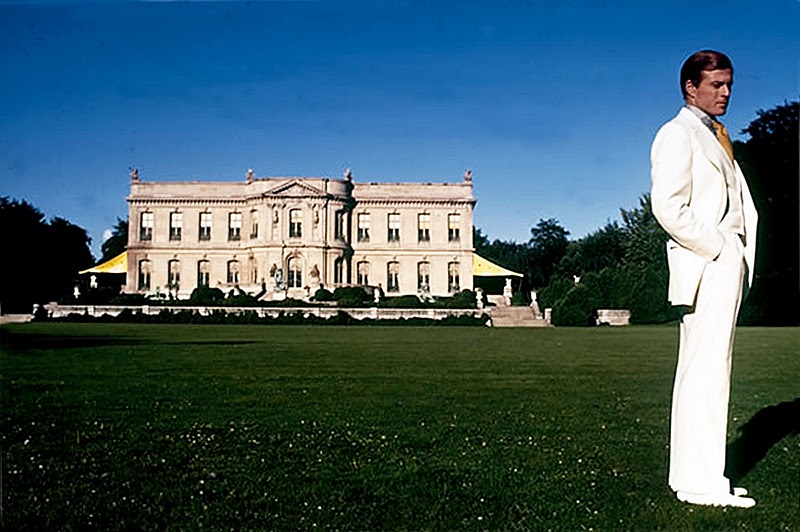
A little trivia related to the book. A number of movie versions of the book were made; the most famous is the one starring Robert Redford as Gatsby.  If for no other reason, it is a must watch to ogle over the young and very handsome Redford, immaculately dressed in some amazing Ralph Lauren suits. His suits started a new revolution in the fashion industry and I came across (thanks to Google) a cover of GQ magazine (March 1974) featuring Redford in a Gatsby getup. I wonder why this image is not used as a book cover!

Another trivia; there is a computer game based on the book also! I thought of downloading it but the source site seemed a little shady, so I just downloaded this picture.  

Pictures: Google Images